November 19, 2009 - 5:06am
| WFED's Max Cacas | |
| Neither the Federal Protective Service, nor contract security guards, is the final word on security in your federal building. | |
Download mp3
|
|
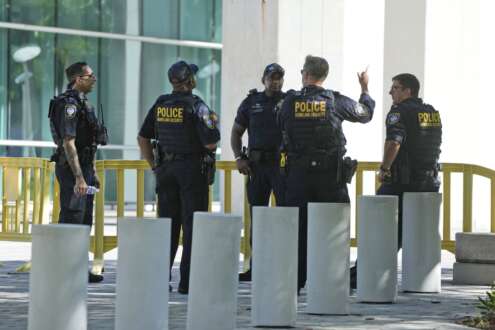
The House Homeland Security Committee has resumed its look at the Federal Protective Service. The agency, which is responsible for security in most Federal government offices, continues to be the subject of intense scrutiny on Capitol Hill.
This is the second hearing this year that the House Homeland Security Committee has held on the Federal Protective Service. And there is no more telling evidence of the problems that continue to beset FPS than a video shown yesterday by the Government Accountability Office.
The GAO'S Mark Goldstein showed a video summarizing a recent investigation, in which investigators were able to easily smuggle the makings of an improvised explosive device into a number of Federal Buildings.
At none of the ten Federal buildings we went into were we stopped. We were able to go into the building with the materials, assemble them in a bathroom, and work virtually unimpeded at many of the offices we went to.
Goldstein testified that the facilities include offices for the Departments of Justice, State, and Homeland Security, and the field offices for a U.S. Senator and a Congressman.
But it was during questioning by Rep. Bennie Thompson (D.-Miss.), the chairman of the Homeland Security Committee, that we learned this interesting, little known tidbit about security at Federal buildings in relation to the GAO investigation.
Gary Schenkel, Director of the Federal Protective Service, said that none of the items that were smuggled into the buildings by GAO investigators were on a proscribed list of items banned from being brought into a federal building.
Thompson asked Schenkel, who decides what's on that list?
Schenkel replied that, "it is determined by the 'facilities security committee' in each building."
As Thompson listened in amazement, Schenkel went on to explain that these committees, often made up of representatives from the agencies who share space in a building, are chaired by the largest agency in many multi-agency buildings. These committees often have no members who are knowledgeable about security matters.
What's more, representatives from the American Federation of Government Employees representing FPS staff, complained that the committees are also able to veto proposals to change security protocols proposed by the FPS.
The panel also learned that agencies are assessed a fee, calculated by the square footage they inhabit, to pay for facility security provided by FPS, no matter what level of security is dictated by either the building or other factors.
Under questioning from Chairman Thompson, Rand Beers, DHS Undersecretary for the National Protection Programs Directorate - the DHS group that is slated to assume management of the FPS in the next few months - testified a summit meeting of FPS officials and representatives from the General Services Administration (which manages rental of many Federal buildings) was convened recently to map out security training for all "facilities security committees" and to insure that security-trained personnel also become members of these committees.
Following the hearing, Chairman Thompson told Federal News Radio that he was surprised to hear about the "facilities security committees", and the surprising clout that they wield when it comes to security matters.
"The general assumption is that security is left to professional law enforcement personnel, and this hearing brought out that a committee potentially made up of no law enforcement security personnel is making security policy decisions. We plan to follow up on it, and see what needs to happen to correct that. Because we want to assure the public that as they go in and out of any Federal building, that the security protocols are as robust as possible."
Officials at the Department of Homeland Security also testified that they are currently conducting a top-to-bottom review of the Federal Protective Service to determine staffing, budget, and other needs, as it moves to the National Protection Program Directorate.
(Copyright 2009 by FederalNewsRadio.com. All Rights Reserved.)
Home | About Us | Privacy Statement | Terms of Use | Copyright Infringement | EEO Public File Report | Bonneville International
AP material Copyright 2009 Associated Press. All rights reserved. This material may not be published, broadcast, rewritten, or redistributed.