February 9, 2010 - 1:05pm
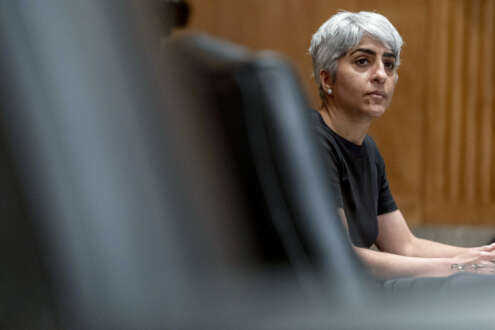
| OPM Director John Berry | |
| Click to hear the entire interview | |
Download mp3
|
|
Federal News Radio has learned that the federal government will be closed on Wed., Feb. 10, 2010.
Federal agencies in the Washington, DC, area are closed. Nonemergency employees (including employees on pre-approved leave) will be granted excused absence for the number of hours they were scheduled to work.
This does not apply to employees on leave without pay, leave without pay for military duty, workers' compensation, suspension, or in another nonpay status.
Telework employees may be expected to work from their telework sites, as specified in their telework agreements.
Emergency employees are expected to report for work on time.
Employees on alternative work schedules are not entitled to another AWS day off in lieu of the workday on which the agency is closed.
Federal employees were given the day off both Monday and Tuesday as the area continued to dig out from a winter storm that dumped over two feet of snow on most of the area over the weekend.
The D.C. region is under a Winter Storm Warning through 7 p.m. Wednesday night. According to the National Weather Service light snow could start as early as Tuesday afternoon with accumulations around one inch.
Additional accumulation of 4 to 8 inches is expected Tuesday night and another 4 to 6 inches could fall Wednesday morning and afternoon.
OPM Director John Berry told Federal News Radio in an exclusive interview Monday that he relies on information from many different sources when making his decision including, daily calls with the Washington region's Council of Governments (COG), updates from the National Weather Service, and advice from local transit agencies like the Washington Metropolitan Area Transit Authority (which runs Metrorail and Metrobus).
Another factor, Berry said, is whether schools are closed. So, even if the decision is made to open the federal government, "I'll always be careful when schools are closed to allow unscheduled leave," he explained.
Berry said he always keeps safety in mind, but also has to consider that the federal government must keep running.
"It is my responsibility to try to maintain, to the greatest extent possible, operations of government. So, a closure is not something we take lightly. There is a cost to it, and we take it very seriously."
The Washington Post reports that closing the federal government for a day due to the weather costs roughly $100 million in lost productivity and opportunity costs.
This is one reason why Berry and other officials have strongly emphasized agency telework policies.
Last Thursday, Feb. 4, the federal government went to unscheduled leave and agencies were encouraged to treat last Friday, Feb 5, as a telework demonstration project day.
"Treat it as if we were facing a true emergency and see how much of your functionaltiy you could key over to telework. I'll be looking forward to seeing some of the reports as to how that went. We just need to get there."
The OPM Director himself teleworked from home on Monday.
"I've been able to stay constantly in touch. I'm current with my emails. . . . Just because people are home doesn't mean they're necessarily vacationing. They are often times maintaining the operations from the government from their homes. . . . Telework works. I didn't have to go jeopardize my aging bones with broken wrists or broken knees or trying to get to an emergency room because I could operate from home very safely. We can do the business of government at home when we need to, and we need to [do] more and more of this."
He added that he is currently working with the administration to drive more focus to the issue of telework and cybersecurity.
"I think we're going to push this one forward. My hope is we can make it part of the routine. We can convince our managers that this can work and that we can drive this into actual practice."
Despite the closures, Berry said there are a lot of feds who have to be at work no matter what, which is why he tries to decide whether or not to close as early as possible based on weather and traffic reports.
"There are folks like our air traffic controllers, our police and prison guards and, in my case, my security staff manage an around-the-clock situation room for me. They're in regardless of the weather."
He added that these feds have to have time to make decisions about when to leave their homes, which is why he works to get the word out everywhere.
"We try to put it in so many outlets. . . . We're exploring [new media]. It is one of the tools that we're looking at and how we can more effectively do that. Part of the challenge, and it's one in government that we have to wrestle with -- we need to get more into the social network situation, but we also have to balance security. Sometimes those two don't go hand in glove, so we do have to balance and move carefully."
Berry said there have been instances where emergency personnel just haven't been able to make the journey. He said in such cases, it is always important for the employee to remain in contact with his or her supervisor so a replacement can be found.
"In many cases, we're talking air traffic control or, as you know, I used to be involved at the National Zoo. Those animals need to be fed every day, whether it's snowing or not. People have to come in regardless of the weather. It doesn't mean that everybody has to come in, but we did have to put together a team so we could get the job done. That's why staying in touch with your supervisor is so essential."
Stay in touch with Federal News Radio throughout the day on your radio at 1500 and 820AM, and online at FederalNewsRadio.com.
We will bring you the latest update on the government's operating plan for Wednesday as soon as it becomes available to us.
Read more: Snow, closings set historic record for federal government
(Copyright 2010 by Federal News Radio. All Rights Reserved.)
Home | About Us | Privacy Statement | Terms of Use | Copyright Infringement | EEO Public File Report | Bonneville International
AP material Copyright 2009 Associated Press. All rights reserved. This material may not be published, broadcast, rewritten, or redistributed.