Jack Moore is a web editor and general assignment reporter for Federal News Radio.
CIO priorities zero in on cloud, cyber as budget uncertainty looms
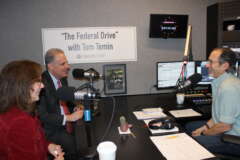
Federal chief information officers remain concerned with securing their agencies' networks and systems. Cybersecurity ranked first in a list of CIOs priorities in an exclusive survey conducted by Federal News Radio. Also among CIOs' top priorities were moving back-office or commodity IT systems to the cloud and using IT to ease the budget pressures facing agencies. Roger Baker, assistant secretary for information and technology and chief information officer of the Veterans Affairs Department discussed the survey results on In Depth with Francis Rose.
TSP returns hold steady through January
The Thrift Savings Plan began 2013 almost exactly how it left off last year. All the regular funds — with the exception of the F Fund, made up of government bonds — and all the target-date Lifecyle Funds posted in positive territory for the month of January.
New SBA union contract emphasizes flexible work policies
The Small Business Administration and the American Federation of Government Employees inked a new three-year deal Thursday, extending a number of flexible workplace policies to more than 2,000 federal employees. Among the new benefits are streamlined telework privileges and the ability for employees to opt in to a four-day work-week with expanded hours each day.
DoD slow to codify some interagency contracting standards
Despite a big policy push from the administration, some agencies have lagged in implementing guidance dealing with interagency contracting, according to a recent report from the Government Accountability Office. Still, GAO said the creation of a policy framework by the Office of Federal Procurement Policy had gone a long way toward ameliorating some of the issues that landed interagency contracting on the watchdog agency's high-risk list eight years ago, such as duplication and unclear lines of authority between agencies.
Employees skeptical of managers' ability to cut deadwood
Federal employees are skeptical their managers are making effective decisions about the federal workforce, according to a new report from the Merit Systems Protection Board. Just 24 percent of the employees agreed that their agencies properly addressed poor performers, while 29 percent of respondents indicated their organizations eliminated unnecessary programs and positions, according to the survey of 42,000 feds from 24 agencies and departments.
HR shuffle changes how agencies work with OPM
The Office of Personnel Management is revamping its human-resources policy shop to provide more innovative solutions to the White House's workforce priorities. The newly created Center for Strategic Workforce Planning will focus on fostering innovation in federal workforce policies and plotting future HR trends. In addition, OPM's human capital officers (HCOs), which previously acted as OPM ambassadors to individual agencies, will instead serve as "HR strategists" to staff the new center and work on pilot projects in priority areas.
DoD's plans to boost cyber workforce could hit hiring, training snags
The Defense Department plans to boost the ranks of cybersecurity professionals, increasing cyber staff at U.S. Cyber Command by more than five times to some 4,900 employees. But DoD's plan is daunting in more ways than one. The job qualifications and skills needed for the kinds of positions the Pentagon wants are rare and often require years of training and hands-on experience. And even if DoD looks outside the confines of the Pentagon to fill these roles, it's not entirely clear where the new cyber pros would come from.
Did OPM flub Monday's delayed arrival announcement?
OPM announced federal offices would be open Monday on a "delayed arrival" schedule. It was the first time the agency has used the classification since it revamped its closure policies last year. But it didn't go off without a hitch - OPM updated the operating status language twice and some federal employees said they were confused by OPM's communication.
Lawmakers call on President to fill widespread IG vacancies
House and Senate lawmakers have called on President Barack Obama to fill inspector general vacancies at six large agencies, including open spots at the Departments of Homeland Security and State.
DFAS halts hiring ahead of possible sequestration
The Defense Finance and Accounting Service will implement significant cost-cutting measures next week to prepare for the possibility of automatic spending cuts due to hit government in March. DFAS plans to freeze most hiring, reduce travel and overtime, and temporarily halt new employee performance awards, according to DFAS Director Terri McKay.
Amid widespread decline, fed membership in unions down slightly
Of the more than 3.5 million workers employed by the federal government in 2012, about 956,000 - or 26.9 percent - were members of unions, according to the BLS data. That's a slight decline from 2011, when 28.1 percent of federal workers were union members.
House postpones federal pay freeze vote
The House has postponed a vote on a bill to extend the federal pay freeze through the rest of 2013. In its place, the House is set to vote on a measure withholding congressional pay unless lawmakers pass a budget — part of a broader deal to extend the debt limit.
Defense workforce caps put key skills at risk
The Government Accountability Office questions whether the Defense Department has done enough to ensure core competencies and key skills aren't lost or left unfilled as the department complies with the workforce caps.
Unions, industry groups spar over impact of sequestration
Guidance from the administration on what steps federal agencies should take to prepare for potential across-the-board budget cuts has set off a war of words between federal-employee unions and industry groups. The American Federation of Government Employees says guidance exempts contractors at the expense of federal employees, but industry groups say the criticism is misguided.
Army freezes civilian hiring, cuts base spending ahead of potential sequestration
The Army has put an immediate freeze on civilian hiring and will begin terminating some temporary employees to reduce spending ahead of potential across-the-board budget cuts later this year. Army Chief of Staff Ray Odierno and Army Secretary John McHugh also directed Army commanders and supervisors to reduce base-operations support spending.
White House: Information sharing a 'key ingredient' in cyber efforts
The White House's new national strategy for information sharing highlights the concept of collaboration in cybersecurity efforts. Michael Daniel, the White House cybersecurity coordinator, told the Federal Drive information security and information sharing are "mutually reinforcing."
AFGE vice president Bowman dies
Dwight Bowman, the national vice president of the American Federation of Government Employees' 14th district, died suddenly Wednesday morning, the union announced.
House bill blocks pay increase for feds
Rep. Ron DeSantis (R-Fla.) introduced a bill that would block a 0.5 percent pay raise for federal workers slated to go into effect March 27. In an executive order issued late last month, President Barack Obama mandated a 0.5 percent pay increase.
House rejects agency budget cuts in Sandy relief bill
The House soundly rejected an amendment to the Superstorm Sandy aid bill that would have required an across-the-board 1.63 percent cut to agency spending to offset the emergency funding. Rep. Mick Mulvaney (R-S.C.) introduced the amendment last week along with a separate proposal to revoke a mass-transit subsidy for federal workers.
USPS aims to boost revenue with special projects, but losses loom large
The cash-strapped U.S. Postal Service can't only cut its way to financial viability. In an increasingly digital world of declining mail volume, it also must find ways to increase revenue, the Government Accountability Office stated in a new report. Currently, USPS is pursuing 55 new initiatives designed to boost revenue.